I thought submitting a doctor’s note would be enough.
When I first requested time away from work because my mental health had begun affecting my ability to function, I assumed that the medical note I received would answer everything my employer needed to know.
Then I received a letter asking for additional health care provider certification.
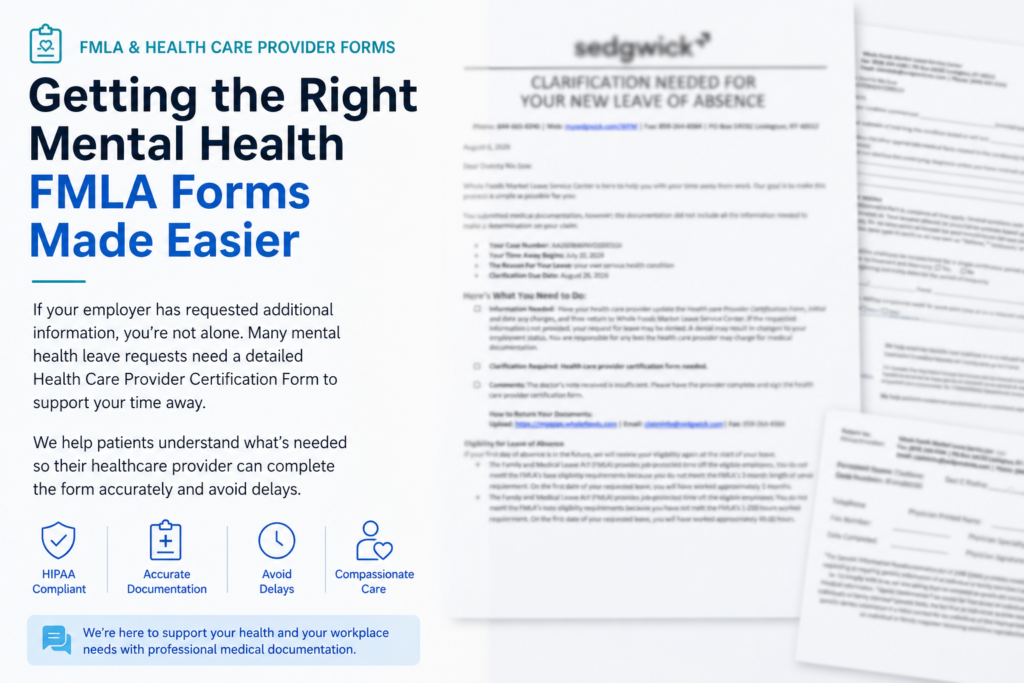
The letter explained that the documentation I had submitted was insufficient and that my health care provider needed to complete a more detailed form. It asked for information about the medical condition, the expected duration, the amount of leave needed, treatment requirements, and how the condition affected my ability to perform my job.
At first, I felt overwhelmed.
I was already dealing with a difficult mental health situation. Now I had another form to understand.
A Doctor’s Note Wasn’t Enough
One of the biggest lessons from my experience was that a regular doctor’s note and an FMLA health care provider certification are not necessarily the same thing.
A basic medical note might confirm that a person was evaluated or needs time away from work.
An FMLA certification can require much more detailed information.
The paperwork I received asked the health care provider to address several areas, including:
- When the condition began
- How long the condition was expected to last
- Relevant medical facts
- Whether continuous leave was medically necessary
- Whether a reduced work schedule was appropriate
- Whether intermittent treatment appointments were needed
- Whether episodic flare-ups could prevent me from working
- How the condition affected essential job functions
Seeing all those questions made me understand why my original documentation had not been enough.
Mental Health Conditions Can Affect Work in Different Ways
My situation wasn’t simply about needing a few days away from work.
My symptoms were affecting my concentration, energy, sleep, emotional stability, and ability to maintain my normal routine.
Some days were manageable.
Other days were considerably harder.
That is one reason medical documentation can be important when dealing with a mental health-related leave request.
The provider needs to document the actual medical circumstances rather than simply state that an employee is “sick.”
The U.S. Department of Labor recognizes that qualifying mental health conditions can constitute serious health conditions under FMLA when the applicable requirements are satisfied.
The Form Asked About Different Types of Leave
Looking at the health care provider form helped me understand that medical leave isn’t always one continuous block of time.
The form included questions about continuous absence, reduced work schedules, intermittent treatment, and episodic flare-ups.
That distinction can be particularly relevant for someone experiencing a chronic or recurring mental health condition.
For example, an employee may need continuous time away from work during a period of significant incapacity.
Another employee may be able to work most of the time but require occasional time away for treatment or periods when symptoms become severe.
FMLA can permit intermittent leave or a reduced schedule in appropriate circumstances when medically necessary.
Explaining How the Condition Affects the Job
Another section of the form asked whether the employee could perform essential job functions.
This was something I had not considered before.
A health condition does not necessarily mean someone cannot work at all.
Sometimes the issue is that particular symptoms interfere with specific responsibilities.
For someone experiencing significant mental health symptoms, this could potentially involve difficulties with sustained concentration, managing high-pressure tasks, maintaining attendance, or functioning consistently during periods of severe symptoms.
The health care provider must make that determination based on the individual’s actual medical circumstances and evaluation.
Why Accurate Medical Documentation Matters
The experience taught me not to treat an FMLA form like ordinary paperwork.
The answers need to be medically supported.
If an employer’s leave administrator sends a clarification request, simply submitting another generic doctor’s note may not resolve the issue.
The appropriate response may be to have the health care provider review the specific certification form and provide the information requested, provided it is supported by the medical evaluation.
This can help prevent unnecessary delays in the leave-review process.
Privacy Was One of My Biggest Concerns
Because my situation involved mental health, I was particularly concerned about privacy.
I did not want to provide unnecessary personal information to my employer.
The U.S. Department of Labor explains that FMLA medical certification needs sufficient information to establish the need for qualifying leave, and a specific diagnosis is not always required.
That helped me understand that appropriate documentation is about providing medically relevant information rather than unnecessarily revealing someone’s entire medical history.
Understanding the Difference Between FMLA and ADA
The paperwork also mentioned reasonable accommodations.
This introduced another important concept: FMLA leave and workplace accommodations are not necessarily the same thing.
Depending on the circumstances, an employee with a health condition may potentially have rights under other federal or state employment protections, including the Americans with Disabilities Act.
Possible accommodations can vary depending on the employee’s limitations and job duties.
Examples may include schedule modifications, leave, or other adjustments when legally required and reasonable.
Because these issues can be complicated, employees should review their specific situation with their employer’s leave or human resources department and, where appropriate, seek professional legal or medical guidance.
What I Would Do Differently
If I had to go through the process again, I would read my employer’s request carefully before scheduling my appointment.
I would bring:
- The employer’s FMLA certification form.
- Any clarification letter I received.
- Information about the dates of leave being requested.
- Relevant treatment information.
- A clear understanding of what the employer or leave administrator was asking the provider to clarify.
Most importantly, I would make sure the information provided to the health care provider was accurate.
Getting Help With Health Care Provider Forms
At NextLevelUrgentCareTexas.us, patients can discuss their medical concerns with a health care provider and bring applicable workplace health care forms for review.
For mental health-related situations, the provider can evaluate the patient’s symptoms and circumstances and determine what documentation is medically appropriate.
If an FMLA certification is appropriate, the provider can complete the applicable sections based on the medical evaluation and information available.
This is different from simply purchasing or requesting a form without an evaluation.
Medical documentation should reflect an actual patient’s medical circumstances.
If Your Employer Says Your Documentation Is Insufficient
Receiving a letter saying your documentation is incomplete can be stressful.
But it does not necessarily mean that the process is over.
Read the clarification request carefully.
Find out what information is missing.
Check the deadline.
Then speak with your health care provider about the specific form your employer or leave administrator has requested.
The provider can determine what information can appropriately be supplied based on the medical circumstances.
Remember that completing an FMLA certification does not automatically guarantee approval of FMLA leave. Employee eligibility, employer coverage, the qualifying nature of the condition, and other requirements still apply.
My Biggest Takeaway
The most important thing I learned was that getting medical documentation is more than obtaining a simple doctor’s note.
When an employer requests an FMLA Health Care Provider Certification Form, the documentation may need to explain the medical facts, anticipated duration, treatment, functional limitations, and type of leave medically necessary.
For someone already dealing with mental health challenges, navigating those requirements can feel overwhelming.
Getting appropriate medical care and understanding exactly what documentation is being requested can make the process easier to navigate.
If you have received an FMLA clarification request or need a health care provider form related to a mental health condition, NextLevelUrgentCareTexas.us can provide a place to discuss your medical concerns and documentation needs with a health care provider.
Your health comes first—and accurate medical documentation can help communicate your medically supported need for time away from work.
